
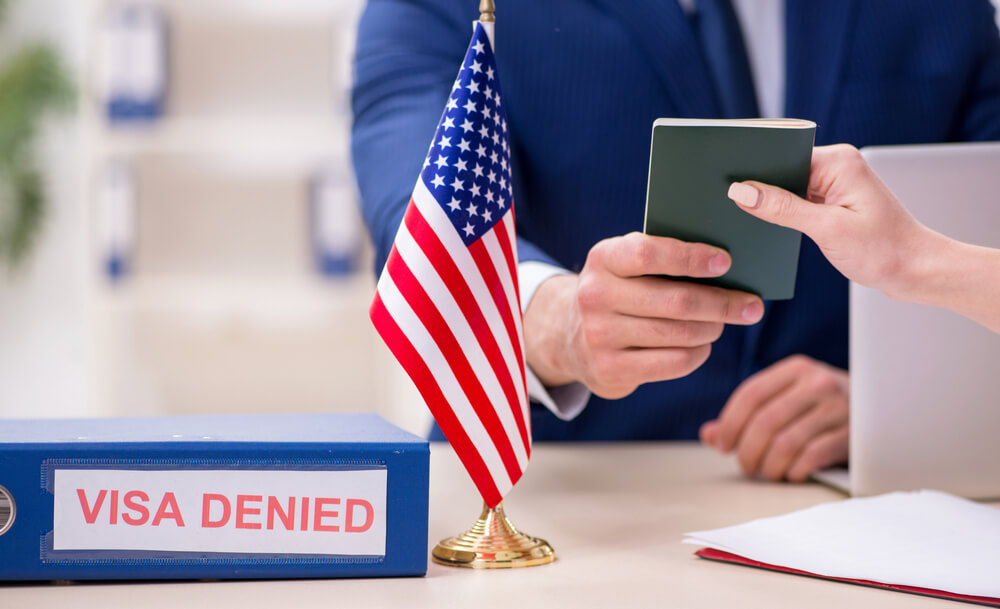
Excitement bubbles inside you as you eagerly wait in front of the visa officer, answering the questions. All the hope is to catch a glimpse of that shiny slip that says, ” Your US visa has been approved!”
But things don’t always go as planned!
You answer all the questions and wait for the result, only to find a dreaded mark of disappointment—a slip that says your visa has been refused.
Nothing can be more frustrating than this.
If your dreams have been caught in a whirlwind for a US visa and tossed aside, leaving you frustrated, then this article is for you.
So, how can I avoid a US visa rejection?
There are many reasons for visitor visa refusals. The good news is that most of them can be easily avoided with careful preparation and visa processing from the outset.
7 Common US Visitor Visa Refusal Reasons
US Visitor visas, also known as B1-B2 visas, can be applied for by anyone with a valid passport/travel document. But that doesn’t mean everyone who applies will get the visa approved.
A US visitor or B1/B2 visa is never guaranteed. However, you can become the strongest candidate by learning the reasons for refusal and preparing properly to avoid them.
So, why are US tourist visas rejected?
- Incomplete or Incorrect DS160 Document
- Unable to Show Logical Purpose of Visit
- Failure to show No Strong Ties to the Home Country
- Poor Communication Skills / Lack of Confidence
- Focusing/Disregarding the Invitation Letter
- Previous Visa Violations records
- Criminal History or Fraud
Reason #01: Incomplete or Incorrect DS160 Document
The most common reason for a US visitor visa refusal is an incomplete or incorrect DS160 form. The Visa officer will reject your visa if your DS160 form is incomplete in its information.
The visa officer will see this visa form during the interview. So what information you provide in the form is important.
Also, your visa will be rejected if the information provided during the interview doesn’t match the documents.
Though US visa officers don’t see the documents, they focus solely on the interview. You should still carry all your documents and proof in the interview.
For instance, carry the papers if you use your investment or property for financial proof. Otherwise, the visa officer can deny your visa.
Reason #02: Unable to Show Logical Purpose of Visit
Every applicant faces a common question during the visa interview – what is your purpose of visiting the US?
Getting the B1/B2 visa largely depends on the answer to this question.
Unfortunately, most applicants reply too casually regarding the purpose of the visit. You must avoid answering like the following:
- I planned to travel in the future, so I decided to apply for the non-immigrant visa
- I want to explore the countryside of the USA
- I planned to stay with one of my cousins, but the details are not finalized yet
When you reply to the question above, be sure you will not get the B1/B2 visa. Instead, you have to be more precise. The purpose of the visit has to be valid. Some valid reasons are:
- Visiting family, children, or other family members
- Joining a meeting or training from your company
- Attending a conference
- Tourism
- Joining a sports event
- In a relationship/engaged/married
Also, make sure your work profile supports the purpose of the visit. Moreover, documents, the DS160 form, and financial status should be relevant to the trip’s purpose. And always try to explain to the visa officer about your positive highlights of life in detail.
- Solution: Prepare to answer a logical purpose for visiting the US.

Reason #03: No Strong Ties to the Home Country
Your B1/B2 visa will be refused if you don’t have strong ties to your home country. It means you will most likely not return to your home country.
Wondering how the visa officer understood it?
Well, your DS160 form & interview will give the visa officer an idea of your ties. An officer will closely review the DS-160 to understand your family situation. They might also ask you questions directly about your family members. If they find the ties to your home country are insufficient, they will reject your visa.
Three kinds of ties are there, including,
- Family: You are the only earning person in your family. So your family depends on you.
- Career: You have a steady or stable job/business.
- Investments: You have already invested in business, lands, or property.
- Solution: Adding as many ties as possible to your DS-160 form, along with supporting documentation, is always best. The more ties you show, the higher the chance of getting the visa.

Reason #04: Poor Communication Skills / Less Confident
Are you confident that you filled out the DS160 correctly?
Are all the relevant documents available?
Can you provide enough valid reasons for the trip?
You need to explain these questions to the visa officer. Great communication skills are essential for explaining your situation. Simultaneously, you have to be confident with your answers.
Also, you should be polite during the interview. Don’t answer with a loud voice. Make sure the visa officer understands your answer clearly. Avoid feeling nervous and make eye contact with the embassy officer.
If you couldn’t understand the visa officer’s question, ask them to repeat it. Politely reply. “I am sorry. Would you please repeat that for me?” Visa officers are extremely friendly, and they will repeat the question.
- Solution: “Practice makes a man perfect” – this proverb will greatly benefit this case. Say your answers with logical explanations in front of the mirror before the interview.
Reason #05: Disregarding the Importance of the Invitation Letter
The invitation letter is a crucial document for a B1 visa. The organization or company you are meeting provides this letter. The invitation letter has to have the following 2 vital features.
- The Letter Must be On the US Entity Letterhead
You can’t carry an invitation letter that doesn’t have the letterhead of the US entity. The invitation letter must have the paper of the US entity. The US entity can now be your organization, company, or client.
- The invitation Letter Must Contain a Precise Explanation of the purpose of the Trip
Most of the time, companies, organizations, or clients provide the invitation letter. Unfortunately, they tend to be too generic, mentioning the visit’s purpose. They show purposes such as “attending training/conference” or “business meeting.”
Such invitation letters are most likely to be refused by the visa officer. It would always be best to be as detailed as possible.
- Solution: Ensuring the reason for your trip mentioned in the invitation letter matches your answer in the visa interview is crucial. Also, your invitation letter must contain the following information,
- Details of the accommodation
- Information on sponsorship
- Dates of your trip
If you are visiting friends or family, or just for tourist activities, an invitation letter is not required, nor should you bring one. So don’t focus too much on the invitation letter if it’s a personal visit.
Reason #06: Earlier Visa Violations Records
Did you apply for a visit visa earlier, and it was denied?
If yes, your new US visitor visa application will be carefully reviewed to see what has changed since your last refusal.
You can ask any consultant or expert about your previous refusal and the possible reasons.
This way, you can better prepare for the future. Also, avoiding earlier mistakes becomes convenient.
Reason #07: Criminal History or Fraud
You may be ineligible for a US visitor visa due to your criminal record and the type of crime. Although not all crimes can make you ineligible. But a criminal record will make it difficult for you to overcome the visa interview process.
Also, visa refusal can happen if the embassy officer discovers visa fraud. Your visa will be refused if your documents show that you provided fraudulent information.
- Solution: If you have a criminal record, it’s best to avoid applying for a US visa. And if everything is okay, prepare the documents so they show you don’t belong to this category.
Frequently Asked Questions (FAQ)
Will a visa refusal affect future visa applications?
Unfortunately, yes. Your previous refusal will affect all your future refusals. If you have one, be prepared to handle the interview well, focus on your strengths, and mention to the visa officers your career, travel history, immovable assets, and family ties.
If my visa is rejected, can I apply again?
Yes, you can. But after a certain time, when circumstances change.
Final Words
The best way to get a US visitor visa approved is to prepare for the visa process. You will easily find resources on the visa interview and process on our site (& YouTube channel).
If I one or two times refused of granting the us visa should I not to tell truth?
No. The previous refusal is in your file and you breach conditions if you falsely declare (lie) and my be refused upon entry and have your visa cancelled on the spot
I don’t know if it’s just me or if perhaps everyone else encountering problems
with your site. It seems like some of the written text within your posts are running off the screen. Can someone else please provide feedback and let me know if this is happening to them too?
This might be a problem with my browser because I’ve had this happen previously.
Thank you
Am planning to apply for a usa visit visa outside my country kenya probably in Botswana or south Africa, is it possible?
These is the same am also facing I want to apply visa but in another country different from where I am staying
I also wan to bt will my bank balance be a prob if dats done?
Si votre solde bancaire est inférieure à 6000$ supposons supérieure ou égale a 2500$ vous ne seriez pas éligible au visa B1-B2?
My wife a Thai citizen, applied for a tourist visa to the U.S. and was denied with no reason. Although present for the interview she was not interviewed and documents showing family ties, property ownership and financial responsibility was not reviewed by the interviewing officer. No information was given that her DS-160 was not complete or was not compliant. I later emailed the U.S. Consulate for reason and cited that I had served 20 years with the U.S. Air Force and 20 years with the U.S. Customs Service to indicate that I would not violate immigration law and keep her in the U.S. Thank you